
Cantilever sliding gates
An automatic sliding gate that hangs from its tower instead of running on a track, so there's nothing across the opening to fill with grit, ice or water. Aluminium, made to order for your opening, clad to match your fence line, and fitted, commissioned and looked after by our own engineers.
- Up to 10mclear drive-through opening
- 3 to 6 secper metre of opening
- 100%duty cycle, for heavy industrial use
- 2.4m or 3mhigh, 3m up to an 8m opening
No track across the opening
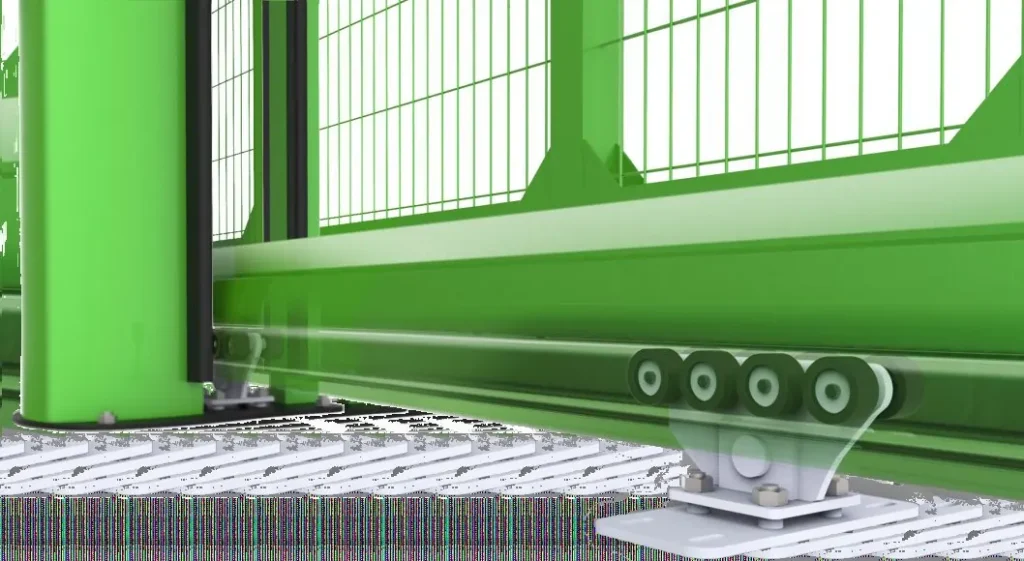
A cantilever gate is longer than the gap it closes. The extra length, the tail, runs behind the main tower, and the whole gate hangs from wheel carriages on the tower and a rear post. It never touches the ground in the opening.
- Nothing to clog or freeze. With no track in the road, there's nothing for grit, leaves, ice or standing water to jam.
- Controlled movement. A rack and pinion drive, watched by an encoder, so the control panel always knows exactly where the gate is.
- Smooth on site power. It runs from an ordinary single phase supply, through a frequency converter that drives a three phase motor, for a soft start and a soft stop.
- Built for the yard. Rated for 100% duty, indoors or out, on sites where the gate never really rests.
The parts of a cantilever gate
The numbers on the drawing match the key.
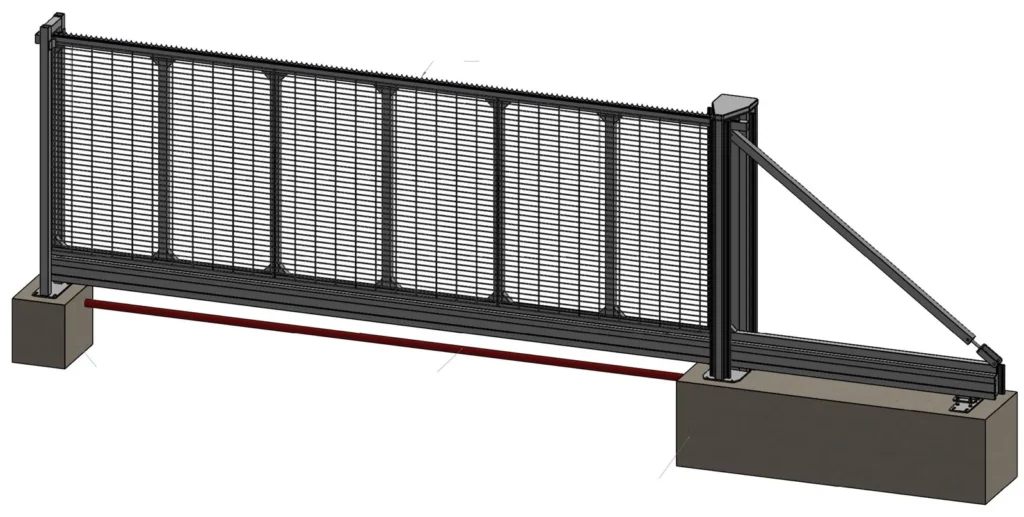
- Anti-climb spikes. An option along the top rail, alongside razor wire or an electric fence.
- Gate leaf. Aluminium frame, clad in the infill that matches your fence line.
- Main tower. Holds the drive, the control panel and the wheel carriages the gate hangs on.
- Counterbalance tail. Runs behind the tower, so nothing crosses the opening and there is no track to clear.
- Ducting for photocells. Laid across the opening before the gate arrives, with mains in a separate duct.
- Catch post. On its own foundation. The gate closes into it.
- Main foundation. C40 concrete, flat and level, with M16 anchor bolts for the tower.
Clad to match the fence line
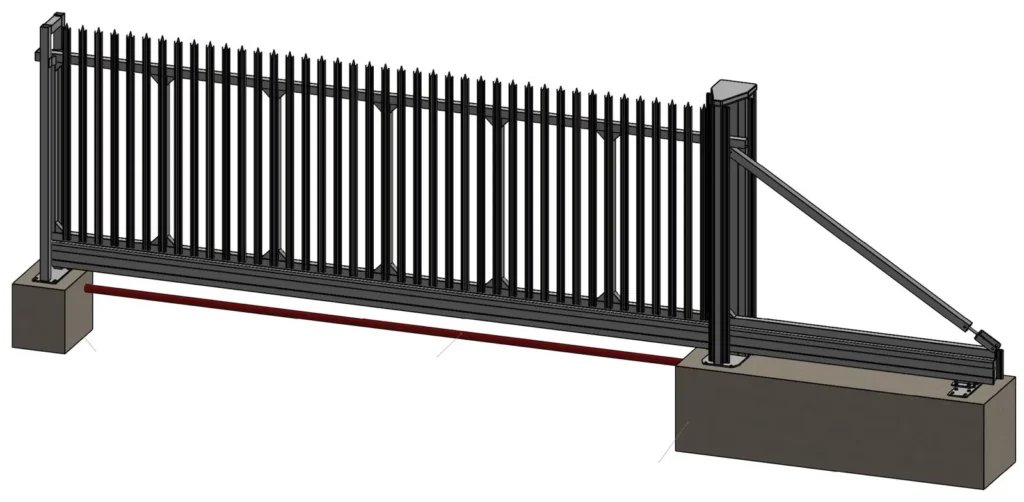
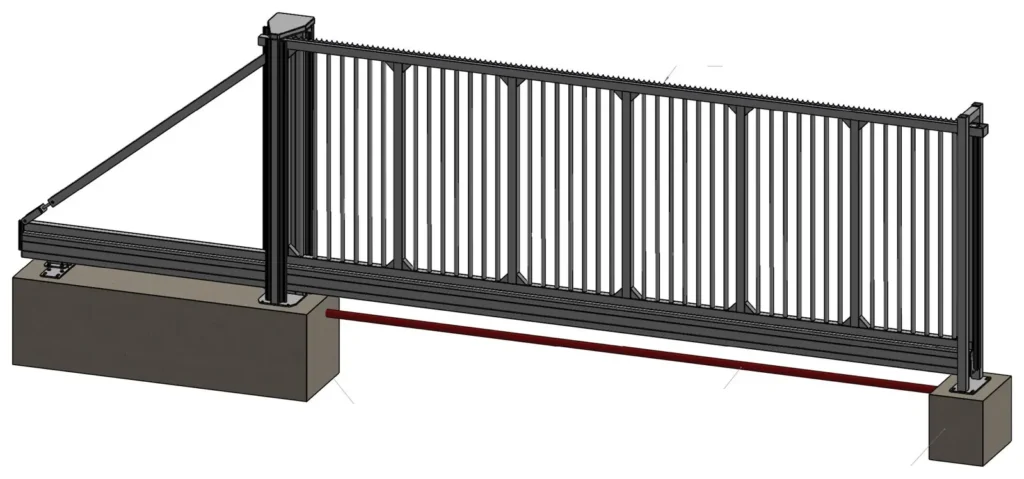
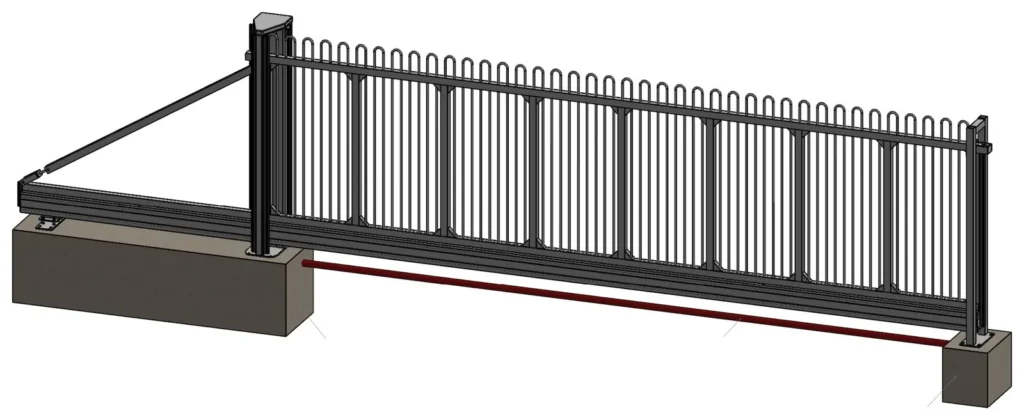
The frame is aluminium, and the leaf can carry almost any infill, so the gate sits in the line of the fence rather than standing out from it. Choose an infill to see it on the drawing.
- Mesh to match welded mesh and 358 fencing.
- Palisade to carry a palisade line through the entrance.
- Vertical tube and bow top for a finished, railed look on business parks and schools.
- Timber and louvre infills where you'd rather nobody saw in.
Finished in any RAL colour.
Safe in use, and set up the way your site works
Dual height photocells
Two beams across the opening, at car height and at a lower level, so the gate won't close on a vehicle or a person.
Six monitored safety edges
Six category 3 safety edges on the leaf and the portal. They're monitored, so a damaged edge is caught by the controller rather than found out the hard way.
A German-made control panel
Set up for the standard ways of working: timed closing, free exit and entry loops, a pedestrian opening and airlock interlocks with a second gate.
Fire alarm input
Ready configured, so the gate does what your fire strategy needs the moment the alarm goes.
Manual release
The gate can be moved by hand if the power is off.
Works with your access control
Fobs, keypads, intercoms, readers and loops all connect, and a pedestrian input is there as standard. Gate access control.
Optional extras: anti-climb spikes, razor wire extensions, an electric fence topping, traffic lights and a warning siren.
The numbers
Every gate is made to order for the opening, so these are the limits rather than a fixed size. We'll confirm the figures for your site at the survey.
| Clear opening | Up to 10m drive-through |
|---|---|
| Height | 2.4m on openings up to 10m, or 3m on openings up to 8m |
| Speed | 3 to 6 seconds per metre, depending on size and infill |
| Duty cycle | 100%, heavy industrial, indoors or outdoors |
| Construction | Aluminium gate leaf and main tower; zinc plated steel tower top, base plate and wheel carriages |
| Weight | About 660kg, depending on size and infill |
| Power | 230V single phase, 50Hz, 10 amps |
| Drive | Rack and pinion with encoder; three phase motor through a frequency converter |
| Safety | Dual height photocells and six category 3 monitored safety edges |
| Colour | Any RAL colour |
Arrives in one piece, ready to bolt down
Free site survey and drawings
We measure the opening and the run-back, check the ground and the power, and you get detailed layout drawings for the foundations and ducts.
Groundworks
Flat, level foundations in C40 concrete for the tower and the catch post, with ducts laid across the opening for the photocells. Mains and access control cables go in separate ducts so they don't interfere.
Delivered fully assembled
The gate comes on a crane lorry, built and ready, and is lifted straight onto its foundation and bolted down. Less time with the entrance open, and less disruption to the site.
Commissioned and tested
We connect the power and the access control, set the safety devices and test the closing forces. We commission every automated gate to BS EN 12453 and hand over the paperwork.
Looked after
Planned maintenance or a call when you need us. Gate servicing and repairs.
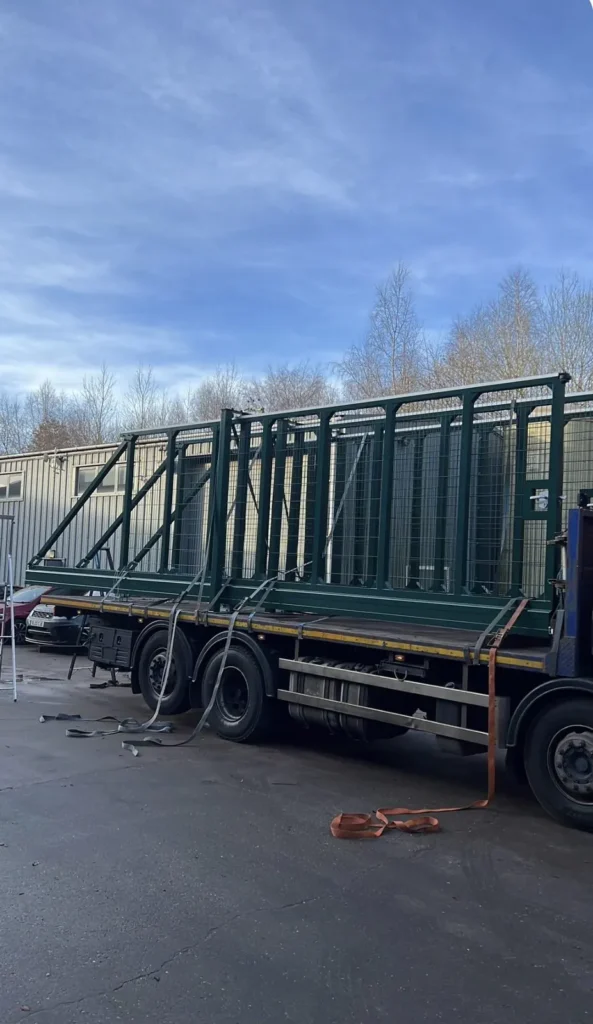
Cantilever gates in different infills and finishes
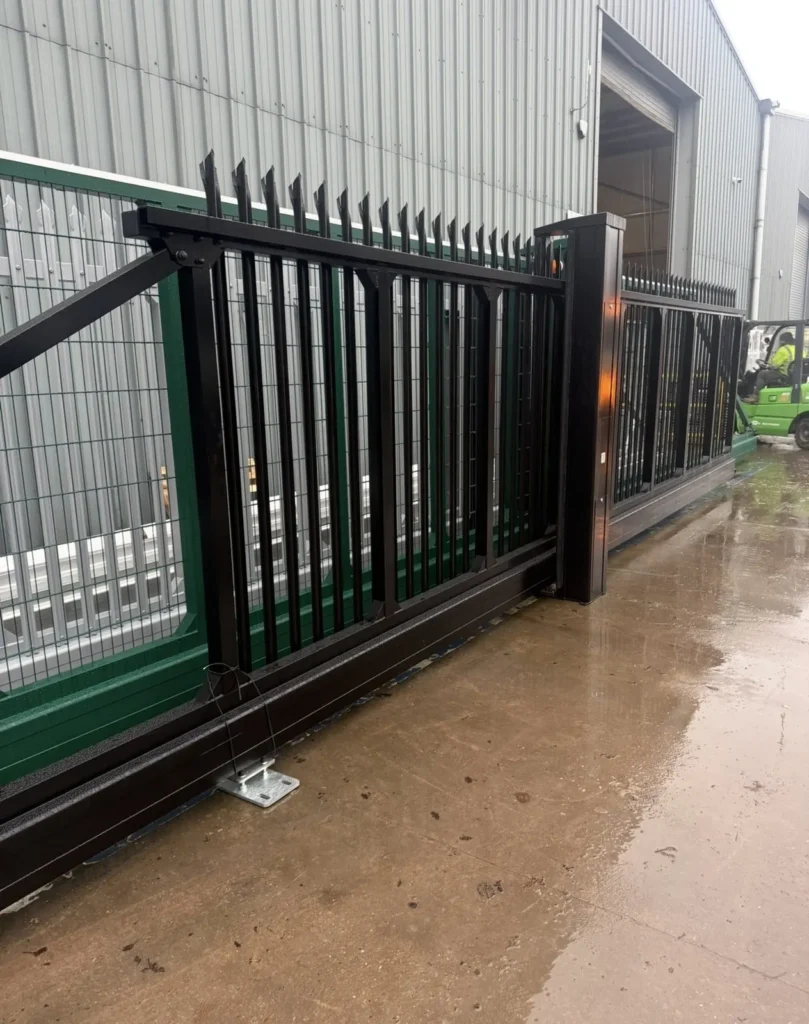
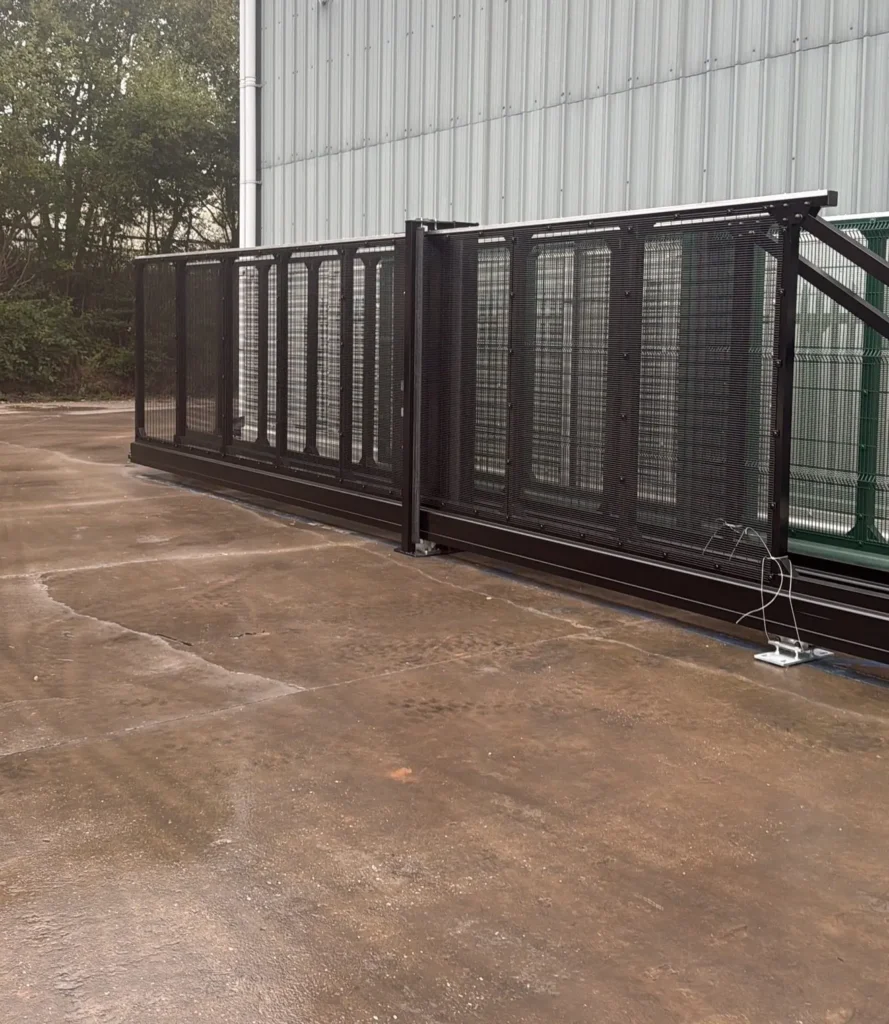
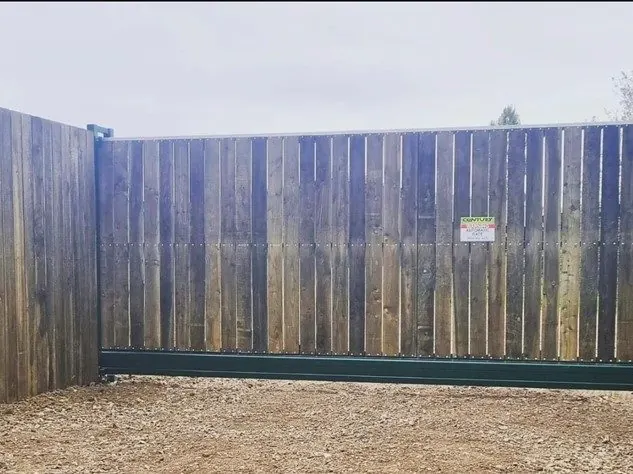
Product photographs and drawings of the range we supply, install and maintain.
Common questions
What is a cantilever sliding gate?
It's a sliding gate that hangs from wheel carriages on a tower and a rear post instead of running on a track in the ground. The gate is longer than the opening, and the extra length, called the tail, sits behind the tower and balances it. Because nothing crosses the opening, there's no track to clear of grit, leaves, ice or water.
How wide can a cantilever gate be?
Up to a 10m clear drive-through opening at 2.4m high, or up to 8m at 3m high. Each gate is made to order for the opening, so we'll confirm the size at the survey.
How much space does a cantilever gate need beside the opening?
More than the opening itself, because the gate has to roll back along the fence line with its tail behind it. As a guide, a gate for a 6m opening takes a little over 9m of fence line from the catch post to the end of the tail. We measure the run-back space at the survey.
What power supply does a cantilever gate need?
A 230V single phase, 10 amp supply to the tower, protected by an MCB rather than an RCD. The control panel turns that into a three phase supply for the motor. The mains and the access control cables should run in separate ducts so they don't interfere with each other.